
Agri-Commodity Export Documentation & Compliance: MRL Testing, COA, and Phytosanitary Protocols
A technical guide for global food importers on auditing Indian agri-commodity export documentation. Covers MRL testing, batch COAs, phytosanitary clearance, FSSAI/APEDA licensing, and container loading protocols.
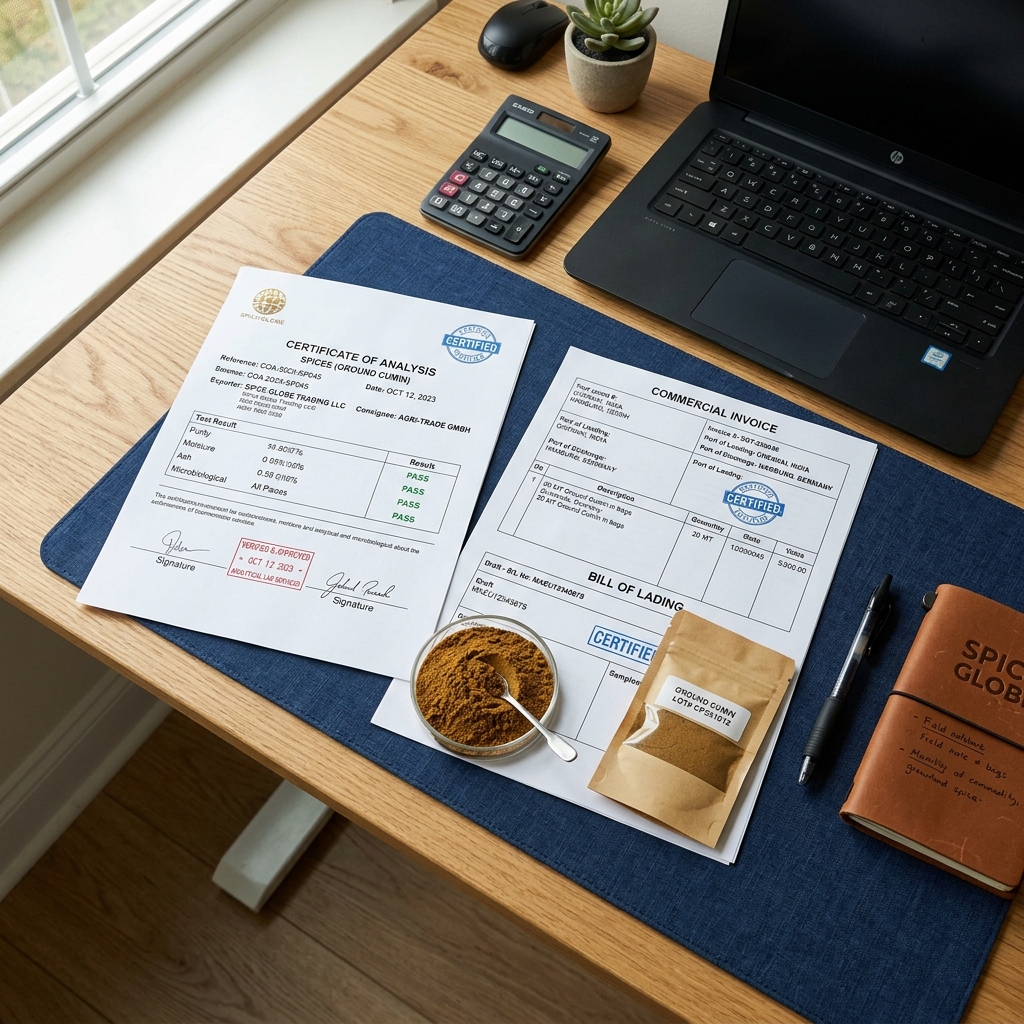
TL;DR: Importing dehydrated vegetables and spices from India requires rigorous paperwork compliance to prevent customs holds. Key mandatory export documents managed by Lokavia include a batch-specific Certificate of Analysis (COA), Phytosanitary Certificate, APEDA RCMC, FSSAI export authorization, and Certificate of Origin. Buyers must audit Maximum Residue Limits (MRLs), heavy metals, and microbiological parameters under our Quality & Sourcing standards prior to vessel loading.
Why Is Export Documentation Critical for Agri-Commodity Imports?
Agri-commodity shipments passing through international customs ports (in Europe, North America, Southeast Asia, and the Middle East) undergo strict physical inspection and documentary verification. Incomplete documentation or mismatched batch analytical parameters can lead to port clearance delays, demurrage charges, or consignment rejection.
Lokavia manages end-to-end export documentation in-house, ensuring every container dispatched from Mundra or Nhava Sheva port arrives with complete, compliant paperwork aligned with Incoterms 2020 (FOB, CIF, or DDP).
What Key Parameters Must Be Verified on a Certificate of Analysis (COA)?
A Certificate of Analysis (COA) is a legally binding document verifying that a specific production lot meets your contractually agreed specifications across our agri-commodities portfolio:
| Testing Category | Key Parameters Analyzed | Industry Standard / Compliance Target |
|---|---|---|
| Physical & Chemical | Moisture, Mesh Size, Total Ash, Acid-Insoluble Ash | Moisture ≤6% (Onion/Garlic), Moisture ≤9% (Ginger) |
| Active Bioactives | Allicin (Garlic), Gingerol (Ginger), Swelling Vol (Psyllium) | Allicin ≥0.3%, Gingerol ≥1.5%, Swell Vol ≥40 ml/g |
| Contaminants & Residues | Pesticide MRLs, SO₂ content, Mycotoxins (Aflatoxin) | EU Reg (EC) 396/2005, SO₂ <10 ppm (SO₂-free grade) |
| Heavy Metals | Lead (Pb), Arsenic (As), Cadmium (Cd), Mercury (Hg) | Lead <2.0 ppm, Cadmium <1.0 ppm |
| Microbiological Safety | Total Plate Count, E. coli, Salmonella, Yeast & Mold | Salmonella Negative in 25g, E. coli <10 CFU/g |
What Documents Are Required for Customs Clearance in the Importing Country?
To clear customs efficiently, international food importers require a complete document package compiled prior to vessel departure:
- Commercial Invoice & Detailed Packing List: Detailing HS codes, net/gross weights, container numbers, and lot numbers.
- Clean On-Board Bill of Lading (B/L): Issued by the ocean shipping line under FOB or CIF terms.
- Phytosanitary Certificate: Issued by the Directorate of Plant Protection, Quarantine & Storage (Government of India) certifying freedom from quarantine pests.
- Certificate of Origin (COO): Issued by authorized chambers of commerce or APEDA to qualify for preferential customs tariff duties.
- FSSAI & APEDA Export License Documentation: Verifying the exporter's legal registration and food safety compliance. See our corporate compliance overview.
- Fumigation & Container Health Certificate: Confirming methyl bromide or aluminum phosphide treatment and clean container condition.
How Does Lokavia Guarantee Container Loading and Quality Control?
Quality assurance does not end at the factory floor. Container stuffing protocols are critical to preserving low moisture levels during maritime transit across high-humidity oceanic zones. Learn more about our sourcing and quality processes:
- Moisture Barrier Liners: Containers are lined with food-grade polyethylene sheeting to prevent condensation drippage ("container rain").
- Desiccant Placement: High-absorption desiccant bags are distributed throughout the container to maintain relative humidity below 50%.
- Palletization & Unitization: Cargo is stacked on heat-treated ISPM-15 compliant wooden or plastic pallets, shrink-wrapped with corner boards for structural stability during sea transit.
- Pre-Shipment Inspection: Every container is inspected for structural integrity, zero odor, and light leaks before loading.
Frequently Asked Questions (FAQ)
Who issues the Phytosanitary Certificate for Indian exports?
The Phytosanitary Certificate is officially issued by the National Plant Quarantine Station under the Ministry of Agriculture, Government of India, following physical sampling and lab examination of the lot.Does Lokavia support third-party lab testing prior to dispatch?
Yes. Buyers can request pre-shipment sampling and testing by independent international inspection agencies such as SGS, Geo-Chem, or Eurofins at the port of loading. For more details, read our frequently asked questions.What is the standard packaging format for export shipments?
Standard bulk packaging consists of 20 kg or 25 kg multi-wall kraft paper bags with an inner heat-sealed 80-micron food-grade PE liner, or 500 kg–1,000 kg jumbo FIBC totes.Need custom documentation or batch COAs? Request a Quote directly from Lokavia International.