
Onion Powder vs. Onion Flakes vs. Onion Granules: Which Form Does Your Food Application Actually Need?
Compare dehydrated onion powder, granules, and flakes across mesh sizes, solubility, bulk density, and food application performance. A technical guide for food R&D and spice procurement teams.
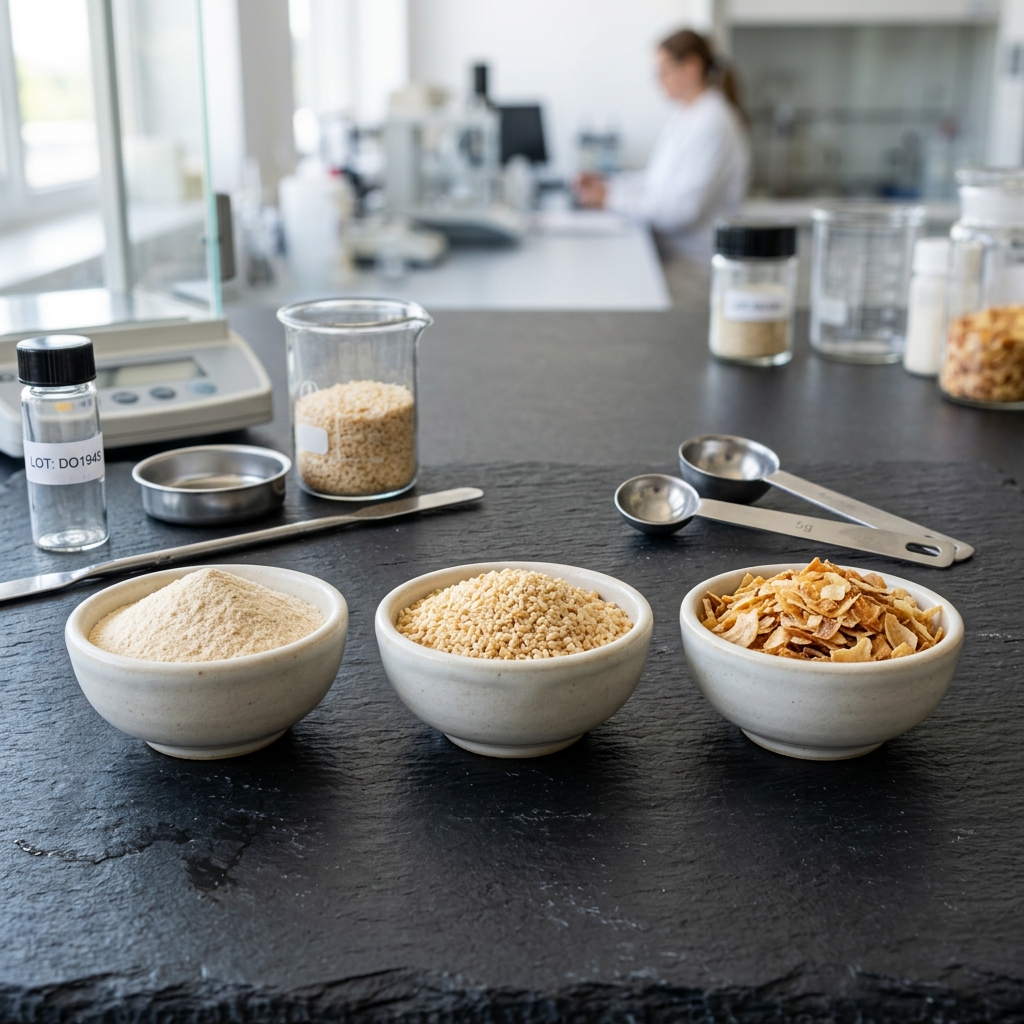
TL;DR: Choosing between dehydrated onion powder, onion granules, and onion flakes depends on your application's required solubility, texture, and processing conditions. Onion powder (80–120 mesh) provides instant flavor dissolution for smooth sauces, soups, and batters. Onion granules (16–40 mesh) offer free-flowing, non-clumping performance ideal for dry rubs and meat processing. Onion flakes (3–10 mm) provide visual vegetable piece identity and texture after rehydration in canned soups, stews, and ready-to-eat meals.

What Are the Technical Differences Between Onion Powder, Granules, and Flakes?
Dehydrated onion products are categorized primarily by particle size, which determines their dissolution rate, bulk density, and visual appearance in food matrices. All three forms are derived from sound, clean, mature Indian Allium cepa L. bulbs (primarily Mahuva white or red cultivars) through hot-air dehydration to a moisture content ≤6.0%. However, their downstream milling and sifting specifications create distinct physical properties:
- Dehydrated Onion Powder: Milled to a fine particle size of 80 to 120 mesh (<0.18 mm), yielding rapid dissolution and uniform dispersion without visible solids.
- Dehydrated Onion Granules: Coarsely milled to 16 to 40 mesh (0.4 to 1.2 mm), balancing moderate dissolution speed with superior flowability and caking resistance.
- Dehydrated Onion Flakes: Sliced and dried into 3 to 10 mm pieces (available as chopped, minced, or large flakes), requiring moisture rehydration to restore vegetable visual identity.
Citation Capsule (Physical Specifications): According to American Spice Trade Association (ASTA) physical standards, dehydrated Allium cepa products share a standardized maximum moisture limit of 6.0% and total ash ≤5.0%. However, bulk density varies significantly: powder averages 0.55 g/mL, granules 0.65 g/mL, and flakes 0.35 g/mL, directly impacting packaging volume and metering equipment calibration.
Technical Comparison Matrix: Onion Powder vs. Granules vs. Flakes
The table below outlines the critical physical, functional, and sensory parameters for food formulation R&D teams:
| Parameter | Dehydrated Onion Powder | Dehydrated Onion Granules | Dehydrated Onion Flakes |
|---|---|---|---|
| Particle Size / Mesh | 80–120 Mesh (<0.18 mm) | 16–40 Mesh (0.4–1.2 mm) | 3–10 mm (Chopped/Flake) |
| Bulk Density | ~0.50–0.58 g/mL | ~0.60–0.68 g/mL | ~0.30–0.38 g/mL |
| Dissolution / Hydration Speed | Instant (<15 seconds in liquid) | Rapid (1–3 minutes) | Slow (10–20 minutes rehydration) |
| Visual Texture in Product | Invisible (Homogeneous) | Subtle Specks | High (Visible Onion Pieces) |
| Hygroscopicity & Caking Risk | High (Requires anti-caking or tight seal) | Low-Medium (Free-flowing) | Very Low |
| Rehydration Ratio (by weight) | N/A (Dissolves) | ~1:3.5 (Water weight gain) | ~1:4.5 to 1:5.0 |
| Primary Food Applications | Smooth sauces, dressings, snacks, batters | Spice blends, dry rubs, processed meats | Canned soups, stews, bakery toppings, meals |
When Should Food Manufacturers Choose Dehydrated Onion Powder?
Food manufacturers should specify dehydrated onion powder when formulating products requiring instant flavor release, homogeneous color, and zero particulate texture. Because 80–120 mesh onion powder dissolves instantly in aqueous systems, it eliminates visible flecks or grainy mouthfeel in smooth liquid formulations.

Key Applications for Onion Powder:
- Emulsified Sauces & Dressings: Ketchup, mayonnaise, salad dressings, and creamy pasta sauces where smooth emulsion stability is critical.
- Snack Seasoning Dusting: Extruded corn snacks, potato chips, and popcorn coatings applied via electrostatic or slurry spray systems.
- Batter & Breading Mixes: Pre-mix flour coatings for fried chicken, fish, and onion ring batters that require uniform savory pungency.
- Dry Instant Soup Powders: Instant noodle seasoning sachets and cream-based cup soups requiring immediate hot-water solubility.
Citation Capsule (Formulation Dynamics): Industrial R&D testing demonstrates that 80-mesh onion powder releases volatile aromatic thiosulfinates 3x faster than coarse granules during high-shear liquid mixing, making it the industry standard for instant savory flavor systems operating under short heat-processing cycles.
Why Are Onion Granules Preferred for Dry Rubs and Seasoning Blends?
Onion granules are the preferred form for dry spice blends, seasonings, and meat processing due to their excellent free-flowing properties and resistance to clumping. The 16–40 mesh size profile closely matches the particle size of granulated garlic, table salt, cracked black pepper, and paprika.
This uniform particle size matching prevents gravity separation during high-speed automated packaging lines and transportation, ensuring consistent dosing in every batch.
Key Applications for Onion Granules:
- Barbecue Rubs & Spice Mixes: Retail and commercial seasoning blends where dustless handling and visual particle uniformity are mandatory.
- Processed Meat & Sausage Production: Emulsified sausages, burgers, and canned meats where controlled hydration prevents moisture pockets while delivering even flavor distribution.
- Snack & Cracker Doughs: Baked snack biscuits and crackers where granules provide localized flavor bursts without weakening dough gluten matrices.
- Pizza & Pasta Seasonings: Dry shaker blends for quick-service restaurant (QSR) applications.
Citation Capsule (Industrial Handling): Comparative flowability studies using the Carr Index show onion granules score between 12–15 (classified as 'good flowability'), whereas 100-mesh onion powder scores above 25 ('poor flowability'), reducing hopper bridging in automated spice blending facilities by up to 85%.
When Are Dehydrated Onion Flakes the Superior Choice for Soups and Canned Foods?
Dehydrated onion flakes (chopped or minced) are the superior choice when the final product requires the visual appearance, bite, and mouthfeel of freshly diced onions. When cooked in high-moisture liquids, onion flakes rehydrate to 4.5–5.0 times their dry weight, delivering authentic texture without the labor, waste, and tear-inducing preparation of fresh onions.
Key Applications for Onion Flakes:
- Canned & Frozen Soups, Stews, & Chili: Retort-processed canned foods where long thermal processing fully hydrates the flakes into tender onion pieces.
- Industrial Bakery Toppings: Onion bialys, onion rolls, and savory breads where rehydrated flakes brown appetizingly during baking.
- Ready-to-Eat (RTE) Meals & Meal Kits: Dehydrated rice mixes, stuffing mixes, and instant noodle vegetable packets.
- Pickles, Relishes, & Sauces: Coarse salsa, pasta sauces, and burger toppings needing distinct vegetable particulates.
Citation Capsule (Rehydration Yield): 1 kg of commercial Indian dehydrated onion flakes (moisture ≤6.0%) yields approximately 4.5 to 5.0 kg of rehydrated onion pieces after 15 minutes of simmering at 85°C, offering commercial kitchens a 400% weight expansion yield with zero prep labor.
How Do Mesh Size and Moisture Specifications Impact Food Formulations?
Specifying exact mesh sizes and moisture thresholds in your purchase order is vital to preventing batch failures, clumping, or premature flavor degradation:
- Moisture Control (≤6.0%): Dehydrated onion is naturally hygroscopic. Moisture levels above 7.0% accelerate Maillard browning (darkening) and severe caking during tropical transport or humid storage.
- Pyruvic Acid & Pungency (≥30 μmol/g): Pyruvate concentration measures active pungent flavor strength. High-pungency white onions from Gujarat, India provide maximum flavor potency per kilogram.
- Sulphur Dioxide (SO₂): Standard grades contain SO₂ for color preservation (≤500 ppm or ≤2000 ppm per regional regulation). European food buyers frequently specify SO₂-free (low-sulfite) onion powder for clean-label compliance.
How Do Handling, Bulk Density, and Storage Costs Compare Across Forms?
Bulk density directly dictates your shipping, storage, and container utilization efficiency:
- Container Fill Rate: Granules (~0.65 g/mL) pack tighter into 25 kg bags and sea containers, allowing up to 20,000 kg per 20-ft FCL. Flakes (~0.35 g/mL) require greater volume, filling a 20-ft container at only 12,000–14,000 kg.
- Packaging Integrity: Powder must be packed in double-layer polyethylene liners inside corrugated boxes or multi-wall paper sacks to prevent ambient humidity absorption.
- Shelf Life: Under cool (<20°C), dry (<60% RH) storage, sealed onion powder, granules, and flakes maintain a stable shelf life of 24 months.
How Do You Select the Right Onion Form for Your Food Application?
To select the optimal dehydrated onion format for your production facility, answer these three quick technical questions:
- Does your product require a smooth liquid matrix with zero visible particles? Choose Onion Powder (80–120 Mesh).
- Are you manufacturing a dry spice blend, rub, or automated meat formulation? Choose Onion Granules (16–40 Mesh).
- Do your consumers expect visible onion pieces and real vegetable bite in hot dishes? Choose Onion Flakes (3–10 mm).
Frequently Asked Questions
Q: Can onion granules be used as a direct 1:1 weight substitute for onion powder?
Yes, in terms of dry flavor contribution, 1 gram of onion powder equals 1 gram of onion granules. However, granules dissolve slower in cold liquids and have a higher bulk density, so volumetric measurements (cups/tablespoons) will differ.
Q: What is the difference between white, yellow, and red dehydrated onion forms?
White dehydrated onion provides a clean, sweet-pungent flavor without color tinting, ideal for light sauces and creams. Yellow onion has a stronger, caramelized flavor profile. Red onion retains subtle reddish-purple specks, preferred for specialty salsas and artisan rubs.
Q: Why does onion powder lump in storage and how can food factories prevent it?
Onion powder is highly hygroscopic due to its low molecular weight sugars. Factories prevent lumping by storing unopened bags below 20°C and 60% relative humidity, adding approved anti-caking agents (like silicon dioxide at ≤2.0%), or switching to onion granules for automated dosing lines.
Q: What packaging options are available for bulk export orders from Lokavia International?
Lokavia supplies export-grade dehydrated onion powder, granules, and flakes in standard 20 kg / 25 kg multi-wall paper bags with heavy-duty food-grade inner poly liners, aluminum foil barrier bags, or custom cartoon boxes packed on heat-treated ISPM-15 wooden pallets.
Need Custom Specifications or Bulk Export Pricing?
Whether you require SO₂-free white onion powder, 20–40 mesh granules, or premium toasted onion flakes, Lokavia International provides batch-certified dehydrated onion ingredients with full COA, FSSAI, APEDA, and ISO 22000 compliance.
- Minimum Order Quantity: 2,000 kg (Trial orders available for qualified manufacturers)
- Container Loads: 20-ft FCL (14,000–20,000 kg depending on mesh form)
- Samples: Free 200g–500g lab samples dispatched worldwide via express courier