
How to Read a Certificate of Analysis (COA) for Dehydrated Onion, Garlic, or Ginger Powder
A practical guide for food quality directors and spice procurement managers on interpreting Certificates of Analysis (COA) for dehydrated onion, garlic, and ginger powder from India. Covers physical, chemical, microbiological, and residue benchmarks.
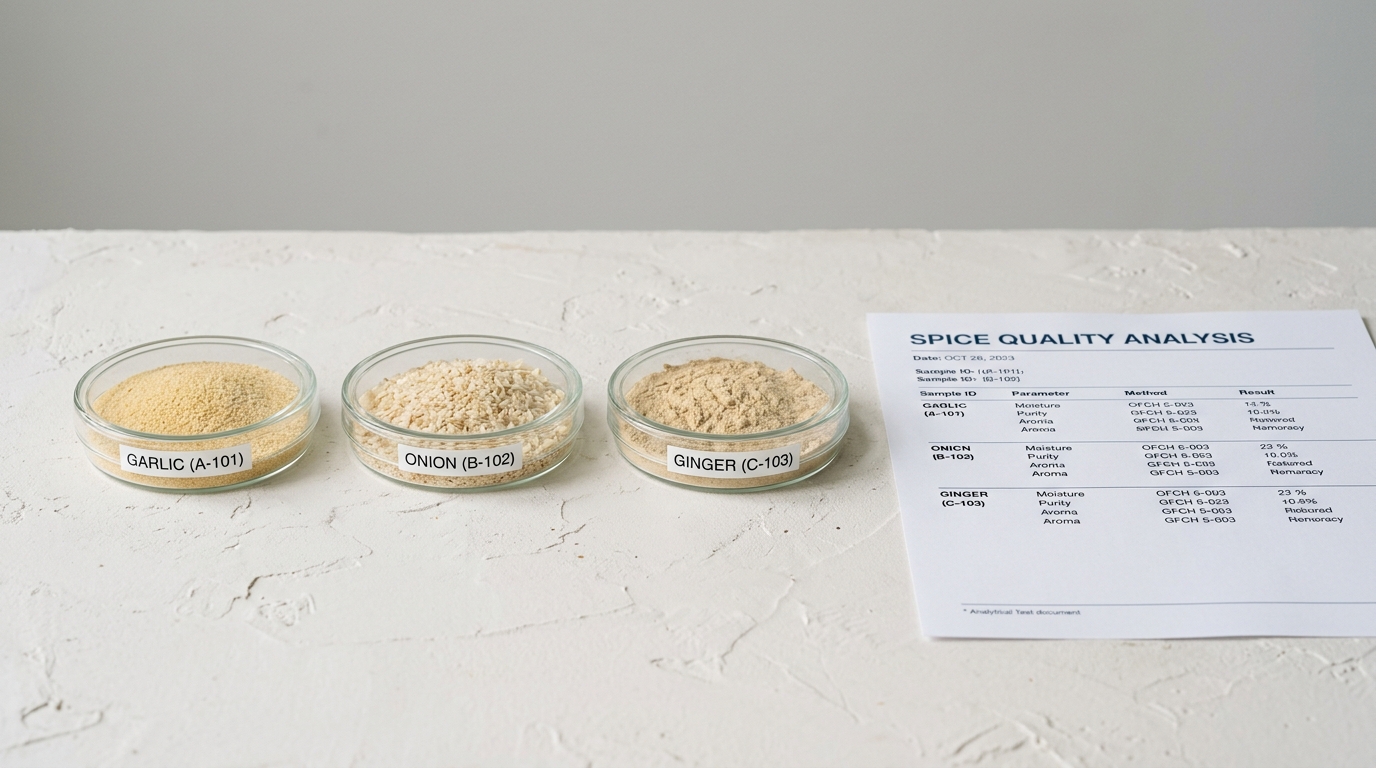
A Certificate of Analysis (COA) is the primary technical document that validates the safety, purity, and functional quality of Dehydrated Onion Powder, Garlic Powder, and Ginger Powder before container loading.
When sourcing from India, procurement teams and QA auditors scrutinize four core sections: physical parameters (mesh size, color, bulk density), chemical benchmarks (moisture ≤6.0%, acid-insoluble ash, allicin/volatile oil), microbiological safety (TPC, Yeast & Mold, zero-tolerance Salmonella), and contaminants (heavy metals, pesticide MRLs). Every export container shipped through Lokavia's quality network is accompanied by a NABL-accredited, batch-specific COA.
What a COA Verifies in Industrial Spice Procurement
A COA provides certified analytical proof for each production lot, safeguarding against:
- Pneumatic Caking & Line Downtime: High moisture causes powder agglomeration in automated auger fillers.
- Flavor Deficiencies: Low volatile oil in ginger or deficient allicin in garlic leads to weak finished food flavor profiles.
- Customs Rejection & Detention: Exceeding destination Maximum Residue Limits (MRLs) or heavy metals can trigger border destruction orders.
1. Physical Parameters & Granulometry
| Parameter | Standard Test Method | Onion Powder | Garlic Powder | Ginger Powder | Commercial Significance |
|---|---|---|---|---|---|
| Mesh / Particle Size | ASTM / US Sieve | 95%+ through 80/100 mesh | 95%+ through 80/100 mesh | 98%+ through 80/120 mesh | Dictates dissolution rate, dusting, and texture in dry rubs and batters |
| Color & Appearance | Visual / HunterLab | Off-white to pale cream | Pale cream to light tan | Light buff to golden yellow | Visual check for scorching or enzymatic browning during drying |
| Bulk Density | Tapped / Poured (g/mL) | 0.55 – 0.70 g/mL | 0.60 – 0.75 g/mL | 0.45 – 0.60 g/mL | Critical for volumetric recipe dosing and packaging fill levels |
| Extraneous Matter | Visual Floatation | < 0.5% max | < 0.5% max | < 0.5% max | Measures plant skin or rootlet fragments |
| Foreign Matter | X-Ray / Magnetic Trap | Nil (0.0%) | Nil (0.0%) | Nil (0.0%) | Zero tolerance for metal, glass, plastic, or stone fragments |
2. Chemical & Physicochemical Benchmarks
- Moisture Content (% by mass): Standard export threshold is ≤ 6.0% (Onion & Garlic) and ≤ 9.0% (Ginger) via Karl Fischer titration or vacuum oven drying (ASTA Method 2.0).
- Total Ash & Acid-Insoluble Ash (AIA): Total ash measures mineral residue after incineration at 550°C (max 5.0%). Acid-Insoluble Ash measures sand, silica, or soil contamination (max 0.5% for onion/garlic; max 1.0% for ginger).
- Bioactive & Volatile Potency:
- Garlic powder should yield ≥ 3,500 – 4,500 µg/g allicin potential upon reconstitution.
- Ginger powder should contain ≥ 1.5% – 2.5% volatile oil (ASTA Method 7.0 Clevenger distillation).
- Sulfur Dioxide ($SO2$): Less than 10 ppm ($SO2$-free). Non-sulfited spices avoid allergen warnings in Western export markets.
3. Microbiological Standards
| Microbiological Assay | Target Limit (Standard Industrial) | Strict RTE / Baby Food Grade | Standard Test Method |
|---|---|---|---|
| Total Plate Count (TPC) | < 100,000 CFU/g | < 10,000 CFU/g | ISO 4833 / FDA BAM Ch. 3 |
| Yeast and Mold Count | < 1,000 CFU/g | < 100 CFU/g | ISO 21527 / FDA BAM Ch. 18 |
| Coliforms | < 100 CFU/g | < 10 CFU/g | ISO 4832 / AOAC 991.14 |
| Escherichia coli (E. coli) | < 10 CFU/g (Absent / g) | Absent in 10 g | ISO 16649 / FDA BAM Ch. 4 |
| Salmonella spp. | Absent in 25 g (or 375 g composite) | Absent in 375 g | ISO 6579 / AOAC 2013.01 |
4. Heavy Metals & Pesticide MRL Screening
- Heavy Metals (ICP-MS): Lead ($Pb \le 1.0\text{ ppm}$), Arsenic ($As \le 0.5\text{ ppm}$), Cadmium ($Cd \le 0.5\text{ ppm}$), Mercury ($Hg \le 0.1\text{ ppm}$).
- Multi-Residue Pesticide Screen: Testing across 500+ compounds via GC-MS/MS and LC-MS/MS ensuring compliance with EU Regulation 396/2005 and US EPA tolerances.
- Ethylene Oxide (ETO) & 2-Chloroethanol: Combined limit < 0.02–0.05 mg/kg for EU compliance.
- Mycotoxins: Aflatoxins total $\le 4.0\text{ ppb}$, Ochratoxin A $\le 15.0\text{ ppb}$.
Common COA Red Flags to Audit
- Theoretical Round Numbers: Generic numbers (e.g. exactly 5.00% moisture across several shipments) indicates a static spec sheet rather than an authentic batch test.
- Missing Standardized Test Methods: Legitimate COAs explicitly reference ISO, AOAC, or ASTA protocols.
- Missing Accreditation Stamp: Third-party reports must include NABL / ISO 17025 accreditation marks.
- Lot Number Inconsistencies: The COA lot number must match outer master carton shipping marks and the Bill of Lading exactly.
Frequently Asked Questions (FAQ)
What is the difference between a Product Specification Sheet and a COA?
A Product Specification Sheet outlines target parameters and allowable tolerances agreed before ordering. A Certificate of Analysis (COA) reports the actual empirical laboratory test results of a specific finished production lot before shipment.Does Lokavia provide third-party independent lab COAs?
Yes. In addition to internal factory QC analysis, Lokavia provides third-party testing from NABL-accredited international laboratories (Eurofins, SGS, Intertek) covering pesticide MRLs, heavy metals, ETO, and microbiological parameters upon request.What is the maximum allowable moisture in dehydrated onion and garlic powder?
The international export standard is ≤ 6.0% moisture by mass. Moisture levels below 5.5% are ideal for high-humidity destination ports to prevent moisture migration and lump formation.How do I verify whether garlic powder has been irradiated or steam-sterilized?
Steam sterilization is confirmed through microbiological clean-count reports alongside negative test results for irradiation (Photostimulated Luminescence / PSL and Thermoluminescence / TL under EN 1788 or EN 13751 standards).Procure Tested, Export-Grade Ingredients from India
Lokavia International supports every bulk order of Dehydrated Onion Flakes & Powder, Garlic Powder, Ginger Powder, and Psyllium Husk with comprehensive batch traceability and verified pre-shipment COAs.
Request a Custom Quote & COA Spec Sheet or review our Quality & Sourcing Protocols for full technical data.